Showing posts with label lighthouses. Show all posts

Wednesday, September 26, 2007

Not Back to School: September 2007

Well as predicted, mother ocean called us back to visit and I couldn’t think of a better place than the Outer Banks in North Carolina. There are some awesome learning opportunities here.

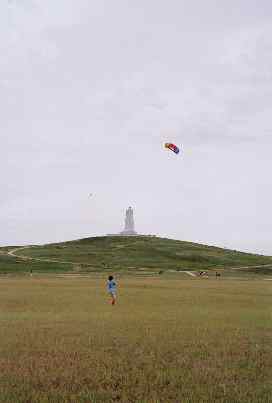
Our studies this year include Aerospace Engineering, and what better place than the state that was “First in Flight”? Our trip included an afternoon flying kites on the very grounds where Orville and Wilbur Wright launched man into the space-age at Kitty Hawk, well really it is Kill Devil Hills, near Jockey's Ridge State Park, but who’s nitpicking on what we remember from our history? Before we left we studied the plane and the kites that were used at the Wright Brothers Aerospace Museum in Dayton, Ohio, but there's nothing like actually going to the place where flight began!


The Currituck Beach Lighthouse is an interesting step back into maritime history as are all the lighthouses in the area. The Whalehead Club has an interesting. It has been restored and is a fun place to visit, as well as the village that surrounds it. It isn’t as bustling as Roanoke or Williamsburg, as it tells a different story. It is a place where you can launch a kayak, have a picnic, catch a Blue Crab.

Also The Outer Banks Center for Wildlife Education, located in Corolla between the historic Whalehead Club and the Currituck Beach Lighthouse had some awesome daily, free programs. There was a class on crabbing, kayaking on the Currituck sound and other items of interest to homeschoolers of all ages.


Hatteras Lighthouse

Bodie Island Lighthouse

The Cape Hatteras National Seashore is an awesome example of maritime life long ago. The Cape Hatteras Lighthouse is just one aspect you;ll find in this area. Cape Hatteras National Seashore preserves the portion of the Outer Banks of North Carolina from Bodie Island to Ocracoke Island, stretching over 70 miles. Included within this section of barrier islands along N.C. Route 12, but outside the National Seashore boundaries, are Pea Island National Wildlife Refuge and several privatecommunities.


The Outer Banks area was once dubbed the "Graveyard of the Atlantic" for its treacherous currents, shoals, and storms and Cape Hatteras has a wealth of history relating to shipwrecks, lighthouses, and the US Lifesaving Service. We went in search of the wreck of the Altoona, a fun outing, but kind of a snipe hunt...next time we'll go better prepared with exact locations and a better map. The Outer Banks folklore is fun to read about and the idea that we were standing on the same beach as Blackbeard was pretty neat seeing how we fancy ourselves as pirates when we go Windjammering....


Currituck Sound Paddlin'

Alligator River Paddlin'

There are many kayaking opportunities at the Outer Banks. We paddled on the Currituck Sound, near the The Outer Banks Center for Wildlife Education and saw mainly marshy terrain. The Alligator River refuge, about an hour inland offered soem pretty interesting paddling as well, thought there was not an alligator to be found! We were treated to three brown bears munching on something in the middle off a grassy field. I think if we ever go back to the Outer Banks , we'll paddle around the Pea Island National Wildlife Refuge. It seemed like an interesting place.


Another bit of local lore I was determined to discover this trip to the Outer Banks was the Wild Horses of Corolla. Locally they are known as Banker Horses and are they something to see running out of the dunes. You need 4 wheel drive vehicle to get to the place where the horses live these days, but it is worth that effort.


So all in all, our celebration of "not" back to school was good. The kid got to try out some Aerospace basics learning to fly a stunt kite at Kitty Hawk and he started reading "Walden" by Henry David Thoureau. He says it's a great book about checkin' out. I agree.

Tuesday, November 08, 2005

I'm Pretty Sure It's Not Poison Ivy - The Whole Story

We often take our schooling on the road. Last February we went to Cabbage Key, Florida to study Botany and Conservation. We're thinking about a return engagement, this time we'l take the kayaks.

My journal from that week...
I'm Pretty Sure It's Not Poison Ivy
Cabbage Key, Florida - February 2005

Monday, February 14, 2005

Log Book: Cabbage Key, Florida USA

Cabbage Key, Florida - February 2005 I'm Pretty Sure It's Not Poison Ivy

DAY 1 & 2
The whole point of Cabbage Key was to study Botany and do nothing. That’s what we did for seven days. Cabbage Key is directly across from marker 60 on the Florida Intercoastal Waterway. That’s due west form Pine Island, Florida, USA. . Sanibel and Captiva islands are 8 miles to the south. The high point of this morning so far was watching Chip the dockmaster at Cabbage Key replace the Channel Mark signs stolen away by hurricane Charley. This high point however was soon replaced by our sighting a lone dolphin scoot by the dock.

We debated if reading "A Farewell to Arms" by Ernest Hemingway is considered doing nothing. But we decided reading was an activity, especially when it’s Hemingway, so we went back to watching the dolphins and the Osprey. My student was learning that it was very difficult to do nothing.

Our “school days” on Cabbage key begin on our dock reading. Along with studying Botany, we’re finishing "A Farewell to Arms" and “Sophie’s World” by Jostein Gaarder. When you travel to an Island that you can only get to by boat you choose your school materials carefully. We thought Botany, Philosophy and Hemingway made an interesting accompaniment to learning the art of doing nothing.


DAY 3
At Cabbage Key we leased the Tarpon Research station. The original buildings on Cabbage Key were built in 1929, by Alan Rinehart and Grace Houghton Rinehart as their winter estate. The Rineharts financed the research lab in 1940. It’s a rustic place and a good place to study Botany. Even though it was clear the effect of hurricane Charley remained, the island was managing to recover. Our study of Botany involves photographing and identifying 40 vascular and 5 non-vascular plants. Cabbage Key is a great place to do just that. So was a neighboring island Cayo Costa.

DAY 4
Cayo Costa is a Florida State park where you can find and abundance of wild life and plant life. We saw osprey, sharks and sea urchins. We also photographed many different plant species. Cayo Costa is another island you can only access by boat but it is well worth the effort. There are secret lagoons, miles of unspoiled beach and acres of wild Florida. This place allows you to imagine what Native Floridians lived like. You can camp at Cayo Costa and there are primitive cabins you can rent, but we chose to stay at cabbage Key.

DAY 5
There are some very good nature trails at Cabbage Key, there is also something very good at the restaurant here. Magically, between the hours of 11 & 2 PM hoards of boats bringing people for lunch ascend on this island. We ate dinner up at the main building but then there is no parade for dinner, so one of these days we’ll meander over there at lunch, but today we’re content watching the boats come and in enjoying our studies on the dock.

They say Jimmy Buffett wrote his song “Cheeseburger in Paradise” at Cabbage Key. There’s a nice photo of him in the bar here. In fact the the bar and the entire main building walls are lines with dollar bills stapled and taped up. There are thousands of them and Mr. Buffet's is framed along with his photo. Today is the day we’re going to go for Cheeseburgers. In fact, that’s the big plan for today, but we’ll see. It is cloudy today, so we don’t expect the parade of boats. At dawn there was a parade of birds at our boatdock however. It might indicate the front they predicted is really going to arrive. Each day I watch the osprey dive for fish at around 4 PM. Today is the first day they’ve been at it this early.

Taking the learning on the road is one of the great things about homeschooing. It can be done rather inexpensively if you choose do it that way, or you can spend a royal fortune; fun, but not really necessary. There isn‘t a tuition paid anywhere that can bring your student what they can learn traveling. We generally travel to a place for a specific reason. In the case of Cabbage Key we wanted to study plants. We took the books: Botany in a Day: The Patterns Method of Plant Identification by Thomas J. Elpel, Guide to the Vascular Plants of Florida by Richard P. Wunderlin, Bruce Hansen, Bruce F. Hansen, Florida Wild Flowers and Roadside Plants by Ritchie C. Bell, Bryan J. Taylor and several rolls of film to photograph plant life so we could assemble a presentation of our study and identify the plants later at home. We always come away from a place with more experience and knowledge than we expect. For example, on this trip my student learned how to navigate a small water craft through oyster beds and mangrove keys.

My student also learned how to “almost catch” a fish as big as himself - or so it looked. Fishing is a big deal here. Many people have large fishing poles on their boats and we can see boats sitting for hours in shallow water fishing. I always imagine what it is like for the fish. It would be like if my cup of coffee here was the bait and when I drank it I would be ripped out of this chair from the face of existence as I know it. Wow.

DAY 6
Today I am going to have another cheeseburger. The main activity yesterday was to find out what the attraction was at the main building at lunchtime, and now I know, it was the burgers. Boy were they good. The other big thing scheduled for today is to talk to the captain who will be taking us back to the mainland. The big decision is to go on Saturday morning or on Sunday morning. The front they predicted arrived, there’s no rain but there are tremendous winds. The temperature dropped from the high 70’s to the mid 50’s, so it’s difficult to do nothing on the dock today. Even a hike on the island’s trails would be difficult because the sand is blowing. We met a man yesterday on the dock that was going camping at Cayo Costa. I thought about him this morning as I made my coffee in semi warmth. He didn’t have a sleeping bag, so I imagine he was pretty chilly. Today is also the first day I had trouble getting my student to do his reading. I suppose everyone who chooses to home school hits difficult days. I think back to the days when I was in a classroom and remember how I longed to be anywhere else but in that classroom and I look at my student being stubborn about reading this morning in this beautiful place. I wonder how many other homeschooling moms play with the idea of sending their students to a school just so they understand how the many of their peers are being educated.