Showing posts with label Architecture. Show all posts

Tuesday, February 13, 2007

It's Good to Be Sunburnt and Greek

One of the really wonderful things about homeschooling and travel is that you get all that great socialization, especially if you are willing to participate in local cultural events.

We went to the Greek Festival in Sarasota, Florida over the weekend. More precisely it was called the Greek Glendi - A Greek Festival hosted by St. Barbara Greek Orthodox Church. According to the program brochure we received, they were celebrating the music of Greece, which fits perfectly with our recent music studies.

There was a lot of music and dancing, with explanations of many of the dances.The St. Barbara Hellenic Dancers were in colorful costumes that showed authentic Greek history and culture. Every Greek costume is an interesting combination of garment and accessories that is characteristic of a group of people who live in a particular region of Greece. According to the narrator at the festival, there are songs for washing sowing, harvesting - there are love songs, lullabies and laments.

The Greek Orthodox Church evolved in the era of the Great Byzantine Empire, for those of you not up on the middle ages. Byzantine chanting is where a lot of the songs we heard came from. These songs were full of melody and harmony. The folk music of Greece claims a history that is long and checkered and worthy of every homeschoolers attention. Popular music commonly known as Bouzouki music possesses unique characteristics that existed in parts of Greece, yesterday and today. The emotions of the Greek people show through in the dances and and in the music we saw and heard.

Greek architecture is a study in itself. Some say the Greeks invented architecture. Anybody who saw the movie "My Big Fat Greek Wedding" understands that sort of enthusiasm for anything Greek. But most Greek Orthodox Churches I have seen so far in our travels are pretty interesting structures and this building in Sarasota is no different. A beautiful dome amidst Palms and Banyon trees adorned with Spanish Moss. If you're interested, you can go inside these churches and see many beautiful icons, lots of candles and gold ornamentation.

Though the music and the architecture are part of the "study" of local culture, at a Greek festival, in our book, the food is always the attraction. Greek pastries and food are the best "fast food" you can get in my opinion. There's nothing better than a Gyro and Baklava and a stroll through the other food and crafts booths. Church festivals always seem to guarantee that homemade touch and the little old Greek Florida ladies were out in force at this one for sure....though none of them had key lime pies on hand...

At the Greek Market

Greek Jewelry

Greek Shaws


Tuesday, May 10, 2005

Painted lady or painted teenager?

Well, I’ve taken a few days off. I recently bought a house that was built in 1880 and we’re in the process of moving in. If you’re an “old house person” I probably don’t need to say anything more, but for those who live in the ‘burbs allow me.

A house that was built in 1880 definitely has “character”, one all it’s own. This house is one of “the painted ladies” in the historic district of our city so we have a lot of “tourists” so we keep the houses looking nice. The color palette I see out my window is better than a Caribbean rainbow. Now typically when you hear “painted lady” you think of the huge Victorians with lots of gingerbread and colors. Many of the houses in our neighborhood are “Folk Victorian” (painted teenagers?). When you look at the color on the houses you can’t help but wonder how much fun the people who live in them must be. There’s a lot of whimsy in the color palette here. The houses are tucked into the hillside and have a view of the river. Many sit on stone foundations, but that’s a story for another day.

A house that is over 100 years old always offers you a project or two and that’s what I have been doing. What does this have to do with our kayak trip? Before I can go , I have to restore the bathroom. It has a bear claw tub and an older pedestal sink and a stained glass window, painted or rusted shut. Need I say more? I did get a break to make our reservations. We’re going to go to Daniel Boone National Forrest The kayak lesson I hope will be on Cave Run Lake. We decided that camping was in order as it is Spring and our camping gear is one of the boxes we have managed to unpack. We’ll be dining on camp food, pondering the sequential paddling instructions we’ll receive and one of us might be playing tiddly winks, or reading Watership Down

Sunday, June 06, 1999

Log Book: Guatemala, Central America

Log Book: Guatemala, Central America, 1999
One of things homeschoolers can do with ease is to add travel to school schedules. At the beginning of the year I look at what sort of topics we plan to explore during the school year, and then my student and I plan our “field trips”. We’ve used field trips for Art, World Culture, Foreign language, Science, Engineering, Geography and History.

One of the best field trips we’ve added to our curriculum was an excursion to Guatemala, Central America. The plan was to visit and learn about the modern and ancient Maya and to practice our Spanish. Before we departed, we made a map of Guatemala and located the places we were going to visit. On the agenda was Antigua, Lake Atitlan, Santiago, Chichicastenango, Tikal and Guatemala City.

We chose March for our visit because we knew there would be many colorful fiestas as this is the most festive time of the year in Guatemala. Antigua was especially colorful as it was once the capital of Guatemala. Antigua has returned to small town status but has a lot of “big city” architecture that survived the years of earthquake activity that caused the capital to be moved to Guatemala City. There are a few “Americanized” places to stay as well as authentic posadas and guest casas.

The high country in Guatemala is not for the accidental tourist. To be a true traveler, you must remember to take the culture as it is and to not compare it to American standards. The rural Mayan live very well and are accustomed to hard work, hard play and a dedication to traditional ways. Spanish is a requirement in the high country, as well as a knowledge of local customs. It is not unusual to see armed military personnel in places like banks and pharmacies. It is also not unusual to see the traditional Mayan walking along the road in the same sort of garb, worn for thousands of years. The latter is more common.

Market day is a colorful event where locals meet and greet each other to buy and sell wares from the different villages. Each village or town has their own color weave and pattern in the garments they wear. Santiago Atitlan, a village that is located on Lake Atitlan, at the base of two volcanoes, is the is the largest, most traditional lake town and is the capital of the Tzutuhil Indians. This village is famous for the quality of weaving and most people still wear the striking traditional costume. Chichicastenango holds one of the largest markets in the high country. Market Days are Thursdays and Sundays, and this has been tradition for hundreds of years.

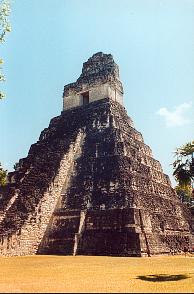
El Peten Itza, home to the famed wood carvers of EL Remate, is also a good base for an outing to Tikal, an excavation in progress. Tikal is the most famous and impressive of the Mayan ruins. 50,000 - 100,000 Mayan lived there at it’s height in 600 AD. Archeologists have recovered 226 square miles of structures and monuments so far. Tikal is an excellent site for observing how these detectives of the ancient world go about their work.


When we returned we built a website to journal our trip: MayaWeb